
A Cinematic Multi‑Chapter Short Story
Chapter 1 — The Door With the Quiet Chime
The bookstore sat quietly between a florist and a café, its windows fogged from the warmth inside. It wasn’t flashy. It wasn’t modern. It simply existed — a refuge for anyone who needed a moment of stillness.

On drizzly mornings, when the street outside glimmered with rain and car tires whispered over the wet pavement, the little shop seemed almost to draw the gray light inward, softening it. The sign above the door was a bit worn, the paint chipped at the edges, but the hand-lettered script still curved gracefully across the wooden board, as if someone had written it with care and never felt the need to change it. The bell over the door was small and brass, the sort that gave a clear, gentle ring whenever someone stepped inside, announcing their arrival without disturbing the calm that lived within the walls.
From the sidewalk, passersby could catch only a suggestion of what waited inside: the vague outlines of tall shelves, the shadow of a ladder propped against a bookcase, and the faint glow of yellow light. The fogged windows, misted over from the contrast of the cool air outside and the cozy warmth within, gave everything a slightly blurred, dreamlike quality. Every so often, a handprint or the shape of someone’s shoulder would appear briefly on the glass as a customer leaned close to peer out, then fade as the warmth reclaimed the surface.
The florist next door often left buckets of fresh flowers on the pavement, and their scent drifted toward the bookstore’s door—roses in the spring, peonies in early summer, and crisp eucalyptus in the winter months. On the other side, the café sent out the smell of roasted coffee beans and fresh pastries, so that anyone approaching the bookstore walked through a gentle cloud of fragrance: flowers, coffee, and, once they stepped through the door, paper and ink and wood. It was the soul-deep smell of old pages and newer spines, of dust that never quite settled and stories that never really slept.
Inside, the bookstore was narrow but deeper than it looked from the street. Shelves climbed almost to the ceiling, their tops lined with oddities left by time—an old globe with fading countries, a chipped ceramic owl, a stack of magazines from decades gone by. The floorboards creaked in familiar places, as if greeting each step with quiet recognition. A rug, slightly threadbare at the corners, stretched across the center aisle, its warm colors dulled by the years yet made more beautiful by the countless feet that had passed over it.
The lighting was soft and uneven, provided by a mixture of hanging lamps, table lights, and a few stubborn bulbs that hummed faintly when switched on. It wasn’t bright enough to chase away all the shadows, but it was perfect for reading. Certain corners held a deeper shade of quiet, where the hum of the street outside felt distant and unimportant. In those corners, it was easy to forget the time, to sit down with a book “just for a moment” and look up much later, startled to see how the light had changed.
Nothing about the place tried to pull attention or impress. There were no neon signs, no glossy displays, no loud music. The front table, just inside the door, was stacked with a mixture of new arrivals and old favorites, arranged with a kind of quiet logic that only long-time visitors understood: a poetry collection beside a worn mystery novel, a slim memoir resting against a hefty history tome. Handwritten notes on little cards offered brief, thoughtful recommendations: “Gentle, hopeful, best read with tea,” or “For anyone who’s ever felt a little lost and needed a map made of stories.”
The chairs scattered throughout didn’t match—one had a faded floral pattern, another was covered in cracked leather, while a third had a patch carefully sewn into the cushion—but they all shared the same inviting slouch. A small wooden bench by the back wall, placed beneath the shop’s tallest shelves, had become a sort of unofficial reading perch; someone was almost always there, legs tucked up, book open, oblivious to the world beyond the page.
The bookstore didn’t make bold promises. It never claimed to change lives or offer answers, yet it quietly did both in small, unassuming ways. People found it when they needed to, sometimes by accident: a traveler ducking in to escape a sudden storm, a tired office worker wandering in on their lunch break, a student looking for a book and discovering, instead, a place where they could finally breathe. Conversations here were soft and sparse, murmured between shelves or exchanged in brief smiles over shared discoveries.
It wasn’t flashy. It wasn’t modern. There were no sleek touchscreens at the counter, just an old register, a jar of pens, and a small dish of paperclips. A simple calendar hung on the wall, its pages marked with scribbled notes about the occasional reading or book club meeting. The music, when there was any at all, came from a small radio tucked behind a stack of books, usually playing something gentle and calm, just loud enough to be felt more than heard.
And yet, for those who stepped inside, the bookstore felt like a kind of sanctuary. Time seemed to slow down within its walls. The outside world—with its noise, its demands, its ceaseless hurry—fell away at the threshold, replaced by the rustle of turning pages and the soft cadence of footsteps on wood. The space held a hush that wasn’t quite silence, more like a quiet held open on purpose, waiting for whoever needed it.
It simply existed — not as a relic or a stubborn refusal to move forward, but as a steady, unchanging presence in a world that moved too fast. It was a place where someone could stand in front of a shelf for long minutes, running a finger along worn spines, and feel no pressure to choose quickly. Where sitting alone with a book didn’t feel lonely. Where a stranger might recommend a novel and, in doing so, share a small piece of themselves without asking for anything in return.
In that modest, time-softened shop between the florist and the café, people found what they didn’t always know they were looking for: a brief pause, a deep breath, a moment of stillness that asked nothing and offered only this—the chance to be quietly, peacefully, entirely themselves, surrounded by stories waiting patiently to be found.
When Hana stepped through the door, the soft chime overhead rang like a whisper. She paused, letting the calm settle around her. The air smelled of cedar shelves, old paper, and cinnamon drifting from next door.
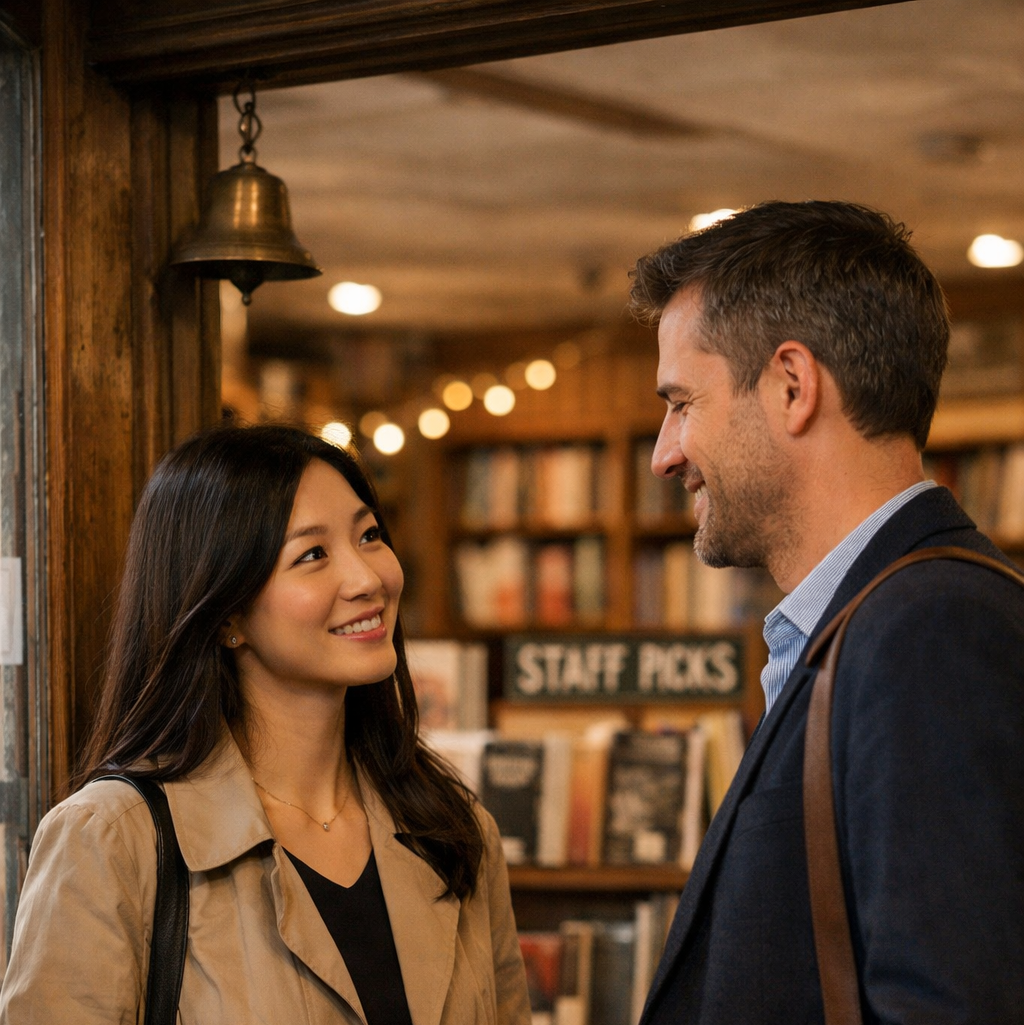
He stood near the entrance, shoulders slightly tense, scanning the shelves as if searching for something he couldn’t name. When he saw her, the tension softened.
“You made it,” he said.
“Of course,” Hana replied, her smile gentle and warm. “I’ve been looking forward to this.”
They drifted into the aisles together, moving slowly, almost reverently. The soft hum of the overhead lights and the distant murmur of other shoppers faded into a kind of gentle background hush as they walked side by side. Neither of them spoke at first; there was a quiet understanding between them, a shared agreement that this moment belonged to silence. Their footsteps made a faint, hollow sound on the polished floor, each step measured, unhurried, as though they were entering a place that deserved a certain kind of respect.
The shelves rose up around them like orderly walls, stacked with familiar labels and colors that seemed strangely significant now. Boxes and cans and jars formed neat rows, each one reflecting the glow of the store’s fluorescent lights. It could have been any ordinary afternoon, in any ordinary store, but it didn’t feel that way to them. There was something almost ceremonial in the way they moved, pausing every few steps to glance at an item, to share a brief look, to breathe in the cool, faintly antiseptic air that carried hints of coffee, detergent, and ripe fruit from somewhere nearby.
They turned the corner into another aisle, still together, their shoulders nearly brushing. The world outside might have been rushing past—cars, clocks, conversations—but here their pace slowed to match the quiet rhythm of their thoughts. Each motion took on a kind of gentle care: the way a hand reached out to straighten a slightly crooked box, the way their eyes lingered on small, ordinary things that suddenly seemed worth noticing. It was as if they had stepped, for a moment, out of the simple act of shopping and into a quiet, unspoken ritual, walking between the shelves as though they were wandering through a place full of small, sacred details only they could see.
To Be Continued
You must be logged in to post a comment.