
The Leather Chairs

In a quiet corner, two worn leather chairs sat beneath a hanging lamp, slightly apart from the hum of the rest of the room. The chairs, cracked along the seams and softened by years of use, faced each other at a gentle angle, as if they had spent a lifetime listening to whispered conversations and half-finished confessions. The lamp above them cast a muted, amber glow, pooling light over the faded rug and turning the dust in the air into slow, drifting constellations. Around them, the distant murmur of clinking glasses and low voices faded into a comforting blur, as though the world had stepped back to give them privacy.
Hana sank into one of the chairs, the leather sighing softly beneath her weight. She moved with practiced ease, as if she had sat there a dozen times before, as if the chair knew her shape and welcomed her back. Crossing her legs gracefully, she smoothed an invisible crease from her skirt, her ankle tipping lightly, heel tracing slow arcs in the air. The warm light caught on the subtle curve of her cheek and the delicate line of her wrist, throwing a soft halo around the edges of her silhouette. For a moment, she let her shoulders drop, allowing herself to relax into the cushioning embrace of the chair, breathing in the faint scent of old leather, dust, and coffee that clung to the upholstery.
He joined her a heartbeat later, the hesitation in his step almost imperceptible but real enough to him. Pulling the opposite chair a fraction closer, he lowered himself into it, feeling the leather resist before yielding. As his back met the worn cushion, he leaned fully into it, letting the chair take his weight. A long, weary breath escaped him—a sigh he didn’t mean to let out, the kind that carried the remnants of the day’s worries and the things left unsaid. The sound hovered between them for an instant, small but undeniable in the quiet.
He caught himself and glanced at her, as if to see whether she had noticed, but the soft curve of her mouth and the calm in her posture gave nothing away. Under the hanging lamp, their faces were lit like two pages in the same open book, each shadow and highlight revealing more than either of them had yet put into words. Outside their small circle of light, the rest of the room blurred into indistinct shapes and muted colors, leaving only the chairs, the lamp, and the fragile space between them that felt, suddenly, like the beginning of something that might matter.
“Tired?” she asked, her voice soft enough that it barely rose above the gentle hum of the room. She stood in the doorway for a moment, just watching him. The lamplight threw warm, uneven patches of gold across the walls, catching on the stack of unfinished papers in front of him and the half-empty mug of coffee that had long since gone cold. His shoulders were hunched, the fabric of his shirt creased where he’d been sitting in the same position for far too long. One hand rested on his temple, fingers pressing lightly as if he could hold the headache in place and keep it from spreading. He didn’t answer right away. Instead, he blinked down at the page in front of him, the printed lines blurring into one another, then lifted his eyes toward her as though it took real effort just to move his gaze. She could see the smudged shadows beneath his eyes, the way his mouth had settled into a thin, tired line that didn’t quite fit the person she knew. He’d been at this desk since before sunset, and now the night outside the window was a deep, unbroken blue, the kind that made the glass reflect back their own dim shapes. She took a few quiet steps into the room, the floorboards giving a familiar creak under her weight. Her question hung there between them, simple and ordinary, but filled with a concern that made her chest feel tight. She already knew the answer—anyone could see it—but sometimes people needed to be asked anyway, needed the invitation to admit it out loud. “Tired?” she repeated, a little more gently, tilting her head as she studied his face, searching for any sign that he might finally surrender and let himself rest.
He nodded. “It’s been… a lot lately.”
Hana didn’t offer advice. She didn’t try to fix anything. She just looked at him with that grounded, attentive expression she carried so naturally.
“You deserve quiet moments,” she said.
Her voice didn’t rise above the soft hum of the room; it slipped between the pauses in conversation, gentle enough that the words felt almost like a secret. For a second, he thought he’d misheard her. The world around them went on as usual—the distant rumble of traffic outside the window, the faint clinking of dishes from the kitchen, the low murmur of a television in another room—but her sentence settled over all of it like a light blanket.
He looked up, frowning in that automatic, defensive way he had when someone showed him kindness he hadn’t asked for. “What?” he asked, half-expecting her to say something practical, something about schedules or chores or the next thing that needed to be done.
Instead, she repeated it, slower this time, as if she wanted each word to have enough space to land. “You. Deserve. Quiet. Moments.”
She didn’t dress the words up with explanations or apologies. She didn’t try to convince him with a list of reasons or remind him of how hard he’d been working. She just offered the sentence to him as it was, plain and honest, like a glass of water placed on the table in front of someone who didn’t realize how thirsty they were.
He shifted in his chair, suddenly aware of how tired his shoulders felt, how long they’d been tense without him noticing. He realized he could hardly remember the last time he’d sat without a screen, without a task, without the buzzing insistence of a notification, a message, a demand. Every moment seemed filled with something: deadlines reaching for him, people expecting answers, worries about money, about family, about the vague but constant fear of not doing enough, not being enough.
Quiet moments. The phrase sounded unfamiliar, almost indulgent. Childhood came back to him in brief, flickering images: afternoons lying on the grass and watching the sky change color; evenings spent with a book and no intention of finishing it quickly; the sound of rain on the windowpane when there was nowhere he needed to be. Back then, silence had been natural, a part of life. Somewhere along the way, it had become a luxury.
She noticed the way his jaw tightened, the way his gaze wandered not to her but to the floor between them. She knew him well enough to see the argument he was preparing: the work that wouldn’t get done, the tasks that would pile up, the responsibilities that didn’t simply vanish because someone said he deserved a break. So before he could speak, she went on, still in that quiet, steady tone.
“You don’t have to earn them,” she added. “They’re not a reward. They’re… just something you’re allowed to have, because you’re human.”
It wasn’t a dramatic moment. No music swelled, no sudden revelation split his life into a “before” and “after.” The light in the room remained the same, the muted gold of late afternoon. But something subtle shifted inside him, a small, almost imperceptible turning.
He let himself imagine, briefly, what it would feel like to have a day with gaps in it—actual spaces where nothing was expected of him. A slow morning with a cup of coffee and no rush to drain it. A walk without headphones, where the only sounds were his own footsteps, the wind, distant voices drifting in from open windows. An evening where he could sit on the couch and simply exist, not scrolling, not planning, not quietly criticizing himself for not being more productive.
“It doesn’t feel fair,” he admitted eventually, the words surprising him as they left his mouth. “When there’s so much to do.”
She nodded, not dismissing his worry. “I know. But it also isn’t fair to ask yourself to be ‘on’ all the time. You’re not a machine. Even machines overheat if they never stop.”
He let out a short, reluctant laugh at that, and she smiled, encouraged by the tiny crack in his resistance.
“Quiet moments don’t erase your responsibilities,” she said. “They just give you a place to breathe between them. To remember who you are when you’re not rushing to the next thing.”
He glanced toward the window. The sky was beginning to soften, streaks of pink and pale blue woven into the fading daylight. It struck him that the world outside moved at its own pace, unaffected by his constant urgency. The trees didn’t hurry to grow their leaves. The clouds didn’t apologize for drifting slowly. The day moved forward whether he was exhausted or at peace.
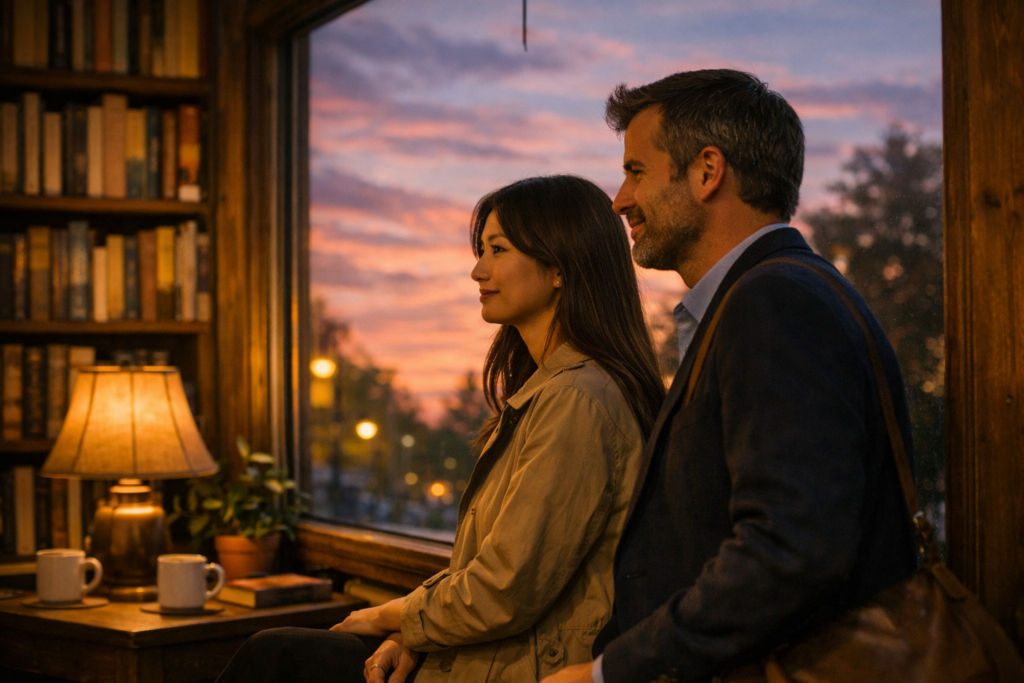
“How?” he asked finally, not sure what kind of answer he was hoping for. “How do I just… take them? I always feel like I should be doing something else.”
She considered this, then shrugged lightly. “You start small. Five minutes where you don’t multitask. Ten minutes where you sit with a book you enjoy, not because it’s important, not because it teaches you something you ‘should’ know, but just because you like it. A walk around the block where you notice the way the air feels, the way people’s windows glow in the evening. A cup of tea you actually drink before it goes cold.”
He rubbed the back of his neck. “And that’s allowed?”
She met his eyes fully now, her gaze steady, the corners of her mouth soft but firm. “Yes. It’s allowed. You’re allowed.” A pause. “And you don’t need anyone’s permission. Not even mine. I’m just… reminding you.”
Something in him eased, just a fraction. The tension didn’t fully disappear, the weight of his life didn’t suddenly lift, but there was now the idea—small and fragile, but present—that maybe rest wasn’t a betrayal of his duties. Maybe quiet wasn’t wasted time. Maybe it was a place where he could return to himself, piece by piece.
“You deserve quiet moments,” she had said.
For the first time, he let the sentence sit inside him without pushing it away. He tried it on, as if it were a coat he wasn’t sure he had the right to wear. It still felt strange, still too generous, but it no longer felt impossible.
He nodded slowly, almost to himself. “Maybe,” he murmured, “I could start with tonight. Just… ten minutes.”
Her smile widened, not triumphant, just warm. “That’s more than you gave yourself yesterday,” she replied. “And that’s enough for now.”
Outside, a breeze stirred the leaves, brushing lightly against the window. Inside, the noise of the day dimmed just a little, as if the room itself had heard her words and decided to soften in response. He didn’t yet know how to live a life with space in it, with stillness that didn’t feel like failure. But sitting there, in the gentle quiet that followed, he realized this was what she had been offering him all along:
Not a solution to everything that weighed him down.
Just permission to set it aside, once in a while, and rest.
They talked about childhood books, about the ones he pretended to read in school, about the ones she rereads every year. Her voice was steady, warm, and unhurried — the kind of voice that makes even simple topics feel intimate.
At one point, he admitted, “I haven’t felt this relaxed in months.”
Hana smiled softly. “I’m glad.”
Leave a Reply
You must be logged in to post a comment.